Subterranean termites cause severe architectural damage in central Mississippi due to high annual rainfall, sustained ambient humidity, and expansive clay soils that hold moisture against stem walls. In historical…
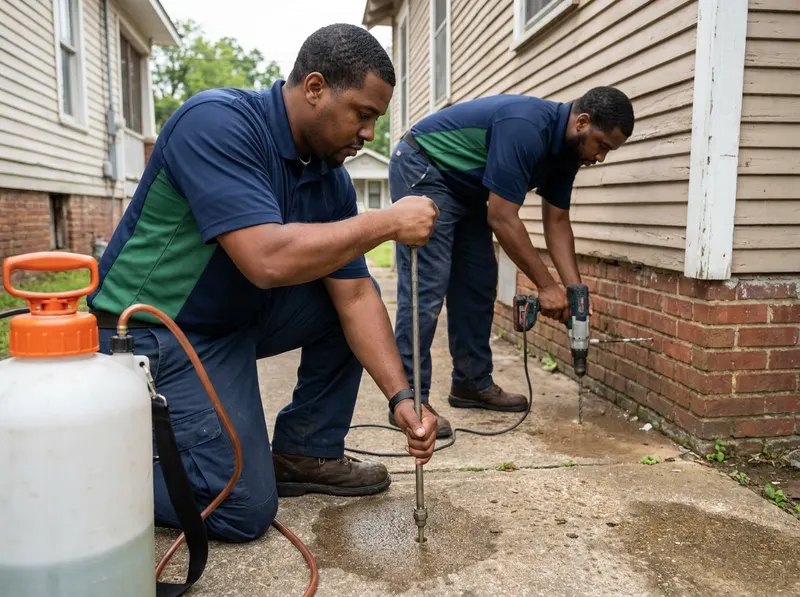
Subterranean termites cause severe architectural damage in central Mississippi due to high annual rainfall, sustained ambient humidity, and expansive clay soils that hold moisture against stem walls. In historical pier-and-beam properties throughout Belhaven and Fondren, termite colonies construct vertical mud shelter tubes across masonry piers to access untreated subflooring, sills, and floor joists. Conversely, monolithic slab homes in Eastover, Broadmoor, and North Colony face termite breaches through interior expansion joints, plumbing penetrations, and bath traps concealed beneath concrete flooring. Left unaddressed, a mature colony of 500,000 workers hollows structural wood internally while leaving exterior paint films intact, masking the compromise until framing members deform.
Eradicating these colonies requires an unbroken chemical perimeter rather than surface repellent sprays. Standard retail solutions and surface-applied pyrethroids merely deflect foraging workers to adjacent untreated studs. Defensive protocols utilize continuous non-repellent liquid termiticides placed directly into the soil along foundation footings. As subterranean workers pass through the treated zone, they contact the undetectable active ingredient and transfer it throughout the central colony through grooming and food sharing (trophallaxis). This bio-transfer systematically collapses the reproductive caste and eliminates the nest at the subterranean source.
Treatment selection depends on architectural design and soil conditions. Continuous liquid soil barrier trenching is suited for homes requiring immediate structural isolation, establishing a 5-to-10-year chemical protection zone. Exterior baiting systems are deployed when crawl spaces are inaccessible or when nearby water features, such as properties bordering the Pearl River basin near LeFleur's Bluff State Park, require restricted liquid soil distribution. While liquid trenching provides instant structural separation, baiting systems rely on worker foraging cycles over 60 to 90 days to achieve full nest death. Homeowners with active internal infestations choose perimeter liquid saturation combined with localized direct-injection foaming to halt structural damage inside wall cavities immediately.
Every job gets a firm, written price after a free on-site visit.
Tell us about your termite control job in Jackson and we'll send a clear, written quote, usually the same day.
 Vexlora Pest Defense