Wild mammals enter Hinds County structures seeking harborage from predators and seasonal temperature shifts. In historic neighborhoods like Belhaven and Fondren, mature water oaks and loblolly pines provide direct…
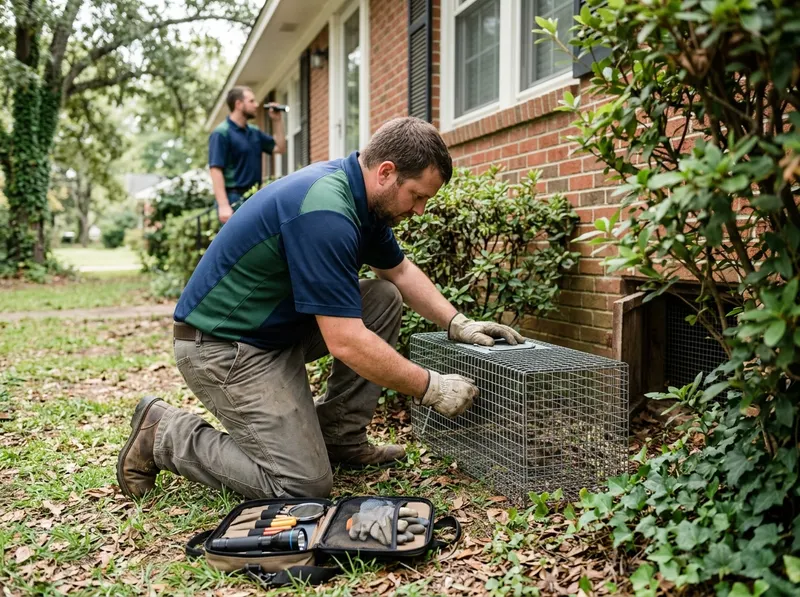
Wild mammals enter Hinds County structures seeking harborage from predators and seasonal temperature shifts. In historic neighborhoods like Belhaven and Fondren, mature water oaks and loblolly pines provide direct canopy pathways for gray squirrels and raccoons to access cedar shake rooflines, fascias, and soffits. In Woodville Heights and West Jackson, unsealed crawlspace vents and foundation piers frequently host burrowing armadillos or female opossums rearing litters. The damp, humid corridor surrounding LeFleur's Bluff State Park and the Pearl River basin maintains unusually dense rodent and mammal populations that routinely compromise structural attic insulation, chew electrical wiring, and contaminate subflooring with biological waste.
Eliminating wildlife requires architectural fortification rather than chemical poison applications. Toxic rodenticides or repellents placed indoors create severe secondary hazards, often causing target animals to die inside inaccessible wall cavities, producing noxious odors and fly breeding cycles. A controlled eviction utilizes mechanical one-way exclusion doors installed over the primary entry run, enabling animals to exit for forage without regaining entry, or state-compliant live trapping placed directly along travel tracks. Once the structural cavity is clear, primary points and secondary vulnerable zones require steel hardware cloth barriers, sealed roof jacks, and reinforced drip edges to prevent secondary breach attempts.
Property owners face distinct operational parameters based on the species present. Gray squirrel intrusions generally present 2 to 6 active animals chewing wood or wiring during daytime cycles, requiring rapid single-hole exclusion. Raccoon occupations frequently involve a mother and 3 to 5 kits concealed inside deep soffit pockets, requiring systematic hand-removal or waiting out weaning periods before permanent barrier installation. Bat colonies operating near the Mississippi Museum of Natural Science or Eastover structures fall under seasonal protection directives, prohibiting exclusion during summer maternal flightless periods (typically May through August) to prevent trapping juveniles inside the attic framing.
Structural repairs separate wildlife control from standard insect management. Trapping animals without reinforcing the structural envelope leaves the home vulnerable to re-invasion by nearby colonies within days. Technicians evaluate every transition seam from the foundation to the ridge cap, installing 1/4-inch galvanized mesh over crawlspace vents, soffit returns, and gable vents to establish an unbreachable structural perimeter.
Every job gets a firm, written price after a free on-site visit.
Tell us about your wildlife removal job in Jackson and we'll send a clear, written quote, usually the same day.
 Vexlora Pest Defense